

If you have ever paid for marketing that delivered a pretty report and not many phone calls, you already know the problem. Finding the best digital marketing agency for small businesses is not about hiring the loudest team or the one with the slickest pitch deck. It is about finding a partner that understands cash flow, limited bandwidth, local competition, and the fact that you do not have six months to waste on vague promises.
Small businesses buy marketing for one reason: growth. More qualified traffic, more booked jobs, more consultations, more checkouts, more repeat customers. Everything else is noise. That is why the right agency is rarely the one offering every trendy tactic under the sun. It is the one that can connect strategy to revenue and explain the plan in plain English.
What makes the best digital marketing agency for small businesses?
The short answer is fit. The better answer is fit plus execution.
A great agency for a small business does not start by selling a package. It starts by understanding the business model, margins, service area, seasonality, sales process, and bottlenecks. A local med spa, a plumbing company, a law office, and a Shopify brand do not need the same channel mix, even if all of them want more leads.
That sounds obvious, but a lot of agencies still sell recycled plans. They use the same ad structure, the same SEO checklist, the same content cadence, and the same monthly talking points for every client. Small businesses usually feel this within the first 60 days. Traffic goes up a little, confusion goes up a lot, and nobody can answer the simplest question: is this turning into revenue?
The best digital marketing agency brings customized strategy, transparent reporting, and practical prioritization. If your website is leaking leads, that gets fixed before anyone starts celebrating impressions. If local search is the real growth lever, local SEO and review strategy matter more than vanity social metrics. If paid ads can work but only after conversion tracking is cleaned up, a smart agency says that upfront instead of burning your budget for sport.
The channels matter, but the order matters more
Most small business owners are not asking for marketing complexity. They are asking for clarity. Should you invest in SEO, Google Ads, social media, a new website, AI search visibility, or all of it at once?
Usually, not all at once.
A strong agency helps you sequence investments. That is a big deal because small businesses do not have enterprise-level room for trial and error. The best digital marketing agency for small businesses knows when to use SEO for long-term growth, PPC for immediate demand capture, website updates for conversion lift, and social content for trust building rather than pretending every channel deserves equal budget.
This is also where modern search changes the conversation. Traditional search is no longer the whole game. People are discovering businesses through AI-generated answers, zero-click search experiences, map results, and conversational tools. If an agency still talks like it is 2021, that is a red flag. Search behavior has changed. Visibility now includes Google, local listings, and AI-driven discovery platforms that influence what users see before they ever visit your site.
For small businesses, that creates both a challenge and an opportunity. The challenge is that old SEO alone may not cover enough ground. The opportunity is that many competitors are behind. An agency that understands AI SEO, ChatGPT search visibility, and zero-click strategy can help a smaller brand gain ground faster than expected.
What to look for before you sign anything
First, look at how they talk. If every answer sounds like a TED Talk with no specifics, keep moving. A good agency should be able to explain what they do, why it matters, what success looks like, and how long results typically take.
Second, ask how they measure performance. You want more than rankings and reach. Those can matter, but they are not the finish line. Ask how they track leads, calls, forms, booked appointments, purchases, cost per acquisition, and return on ad spend where relevant. If reporting is disconnected from business outcomes, the strategy probably is too.
Third, look for proof that they understand small business realities. That means realistic timelines, respect for budget constraints, and recommendations built around your actual capacity. There is no prize for generating 200 leads if your team can only handle 20 well.
Fourth, pay attention to whether they audit before they prescribe. An agency that immediately says you need more ads, more blogs, and a full site rebuild without reviewing your funnel may be selling solutions before diagnosing the problem.
Finally, ask how they adapt. Marketing is not static. Ad costs shift, search features change, local competition moves, and AI platforms keep rewriting the playbook. The right agency is not chasing every shiny object, but it is staying current enough to protect your visibility where customers are searching now.
Red flags that waste small business budgets
Some warning signs are easy to miss because they sound polished in a sales call.
One is guaranteed rankings. No credible agency controls search engines or AI answer engines. Another is suspiciously cheap retainers paired with giant promises. Good strategy, content, optimization, creative, and campaign management take real time. Bargain pricing often means thin execution.
Another red flag is channel obsession. If an agency only believes in one thing, whether that is SEO, paid ads, or social media, your business may end up forced into their comfort zone instead of your best-fit strategy. Small businesses need flexibility, not ideology.
Watch for weak communication too. If they take days to answer basic questions before you sign, imagine the experience after onboarding. Transparency should not begin after the first invoice.
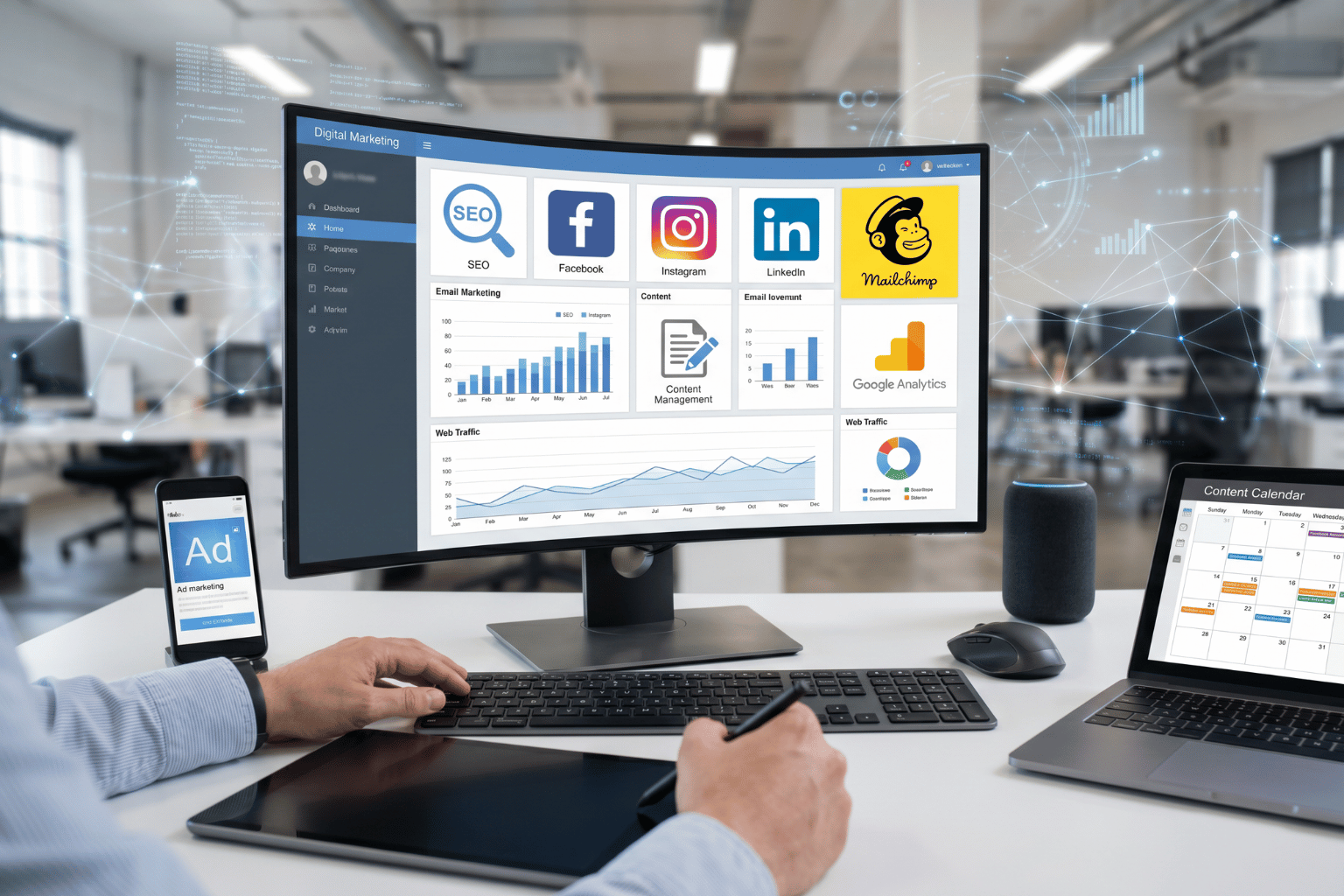
And yes, flashy dashboards can be a distraction. A report can look impressive while your lead quality gets worse. Clean visuals are nice. Useful interpretation is better.
Why AI visibility now belongs in the conversation
A few years ago, most agency comparisons focused on SEO versus PPC. That is no longer enough.
More users are getting answers directly from search results and AI assistants. That means your brand may be judged, cited, or skipped before a prospect ever clicks through. Small businesses that rely only on old-school ranking reports may miss where discovery is actually happening.
This does not mean every business needs a giant AI strategy overnight. It does mean your agency should understand how your content, site structure, local signals, reviews, topical authority, and brand mentions affect visibility across emerging platforms. It also means they should know how to build for both human conversion and machine interpretation.
That combination is still surprisingly rare. Many agencies either know traditional SEO and ignore AI discovery, or they talk about AI in a hand-wavy way with no operational plan. The sweet spot is practical implementation. What should be changed on the website? What content gaps matter? How should local authority be strengthened? Where are zero-click losses happening? Those are useful questions.
The best agency is rarely the biggest one
Small businesses often assume a large agency equals better results. Sometimes it does. Often, it just means more layers, less agility, and a junior team doing the actual work.
A focused agency that understands small business growth can be a better fit because it knows how to prioritize. It knows that a faster site, better local optimization, tighter ad targeting, and clearer conversion paths can outperform a bloated strategy built for boardroom presentations.
The relationship matters too. You want a team that sees the business behind the metrics. One that understands your busy season, your sales cycle, your geographic targets, and the difference between a lead and a good lead. That kind of context usually produces better decisions than generic account management.
For that reason, many small businesses do best with agencies that combine deep search expertise, paid media skill, web conversion know-how, and modern AI visibility strategy in one plan. That mix keeps channels from fighting each other and gives you a clearer picture of what is actually working. Agencies like LAv1 are building around that model because it reflects how customers now find and choose businesses, not how marketers wish they still did.
How to make the right choice without overthinking it
Start with your actual goal. Not “better marketing.” Be specific. More calls from local search. Lower cost per lead. Better lead quality. More booked consultations. Higher e-commerce conversion rate. Faster growth in a defined service area. The clearer your goal, the easier it is to judge whether an agency is equipped to help.
Then ask for a realistic path, not magic. What would they fix first? What can move in 30, 90, and 180 days? What depends on budget, competition, and internal follow-up? Strong agencies are confident, but they do not pretend every result is instant.
You should also trust your own reaction. If the conversation leaves you feeling more confused, that is a problem. Good agencies simplify without dumbing things down. They make you feel informed, not managed.
The best digital marketing agency for small businesses is the one that can meet you where you are, tell you the truth about what is and is not working, and build a growth plan that respects your budget while pushing your business forward. That is not flashy. It is just effective. And for a small business owner trying to turn marketing into momentum, effective beats flashy every time.