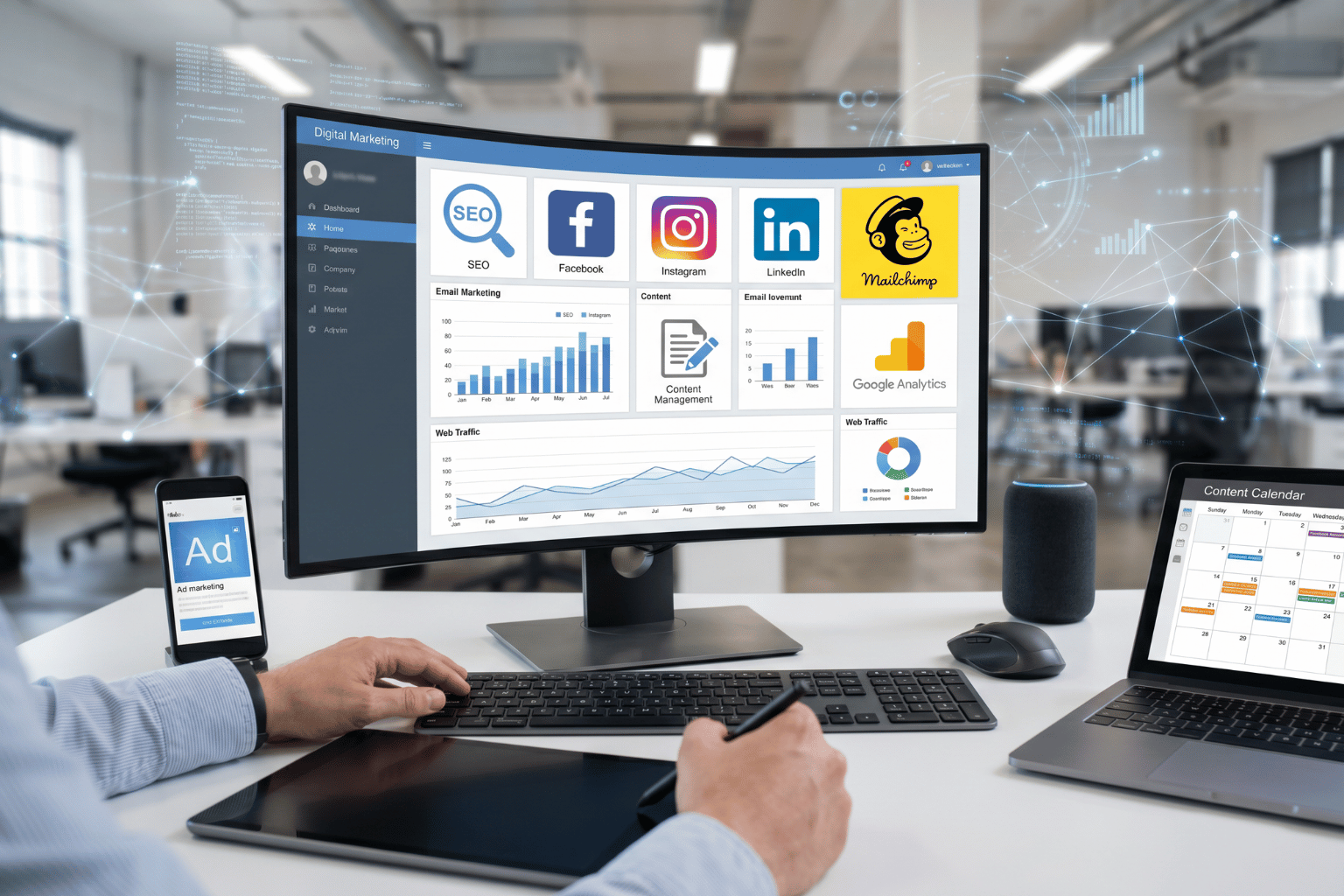


Most small business owners do not have a tool problem. They have a time problem, a clarity problem, and sometimes a too-many-tabs-open problem. That is why choosing the best digital marketing tools for small businesses is less about grabbing the flashiest software and more about building a stack that actually helps you get leads, track results, and stop guessing.
The good news is you do not need 25 platforms and a full in-house team. You need a few tools that cover the basics well: visibility, traffic, lead capture, follow-up, and reporting. The better news is that some of the most useful tools are practical, affordable, and realistic for lean teams.
What makes the best digital marketing tools for small businesses?
A good tool should save time or make money. Ideally both. If it adds complexity without improving performance, it is not helping your business. That sounds obvious, but plenty of small companies end up paying for software built for enterprise teams with six layers of approvals and someone whose entire job is dashboard maintenance.
For most small businesses, the right tool checks four boxes. It is easy to use, supports measurable outcomes, plays nicely with the rest of your stack, and fits your budget without trapping you in features you will never touch. Another factor matters more now than it did a few years ago: whether the tool helps you show up across both traditional search and AI-driven discovery.
That last point is becoming a real differentiator. People are not only searching on Google. They are also asking AI platforms for recommendations, summaries, and service provider suggestions. If your tools only help with old-school traffic tracking and ignore AI visibility, you are already a step behind.
1. Google Business Profile
If you serve a local market, this is non-negotiable. Google Business Profile remains one of the highest-ROI tools available because it influences local map visibility, calls, website clicks, reviews, and foot traffic.
For a local service business, a well-optimized profile can outperform a lot of paid efforts. It helps you appear when someone nearby is ready to act, which is exactly when you want attention. The trade-off is that it needs active management. Neglected profiles with outdated hours, weak photos, and unanswered reviews lose momentum fast.
2. Google Analytics 4
You cannot improve what you do not track. Google Analytics 4 gives you a clearer look at where your traffic comes from, which pages people visit, and what actions lead to conversions.
Yes, GA4 still frustrates people. That is not your imagination. But even with its learning curve, it is one of the most important tools in your stack because it helps answer basic business questions: What is working? What is wasting money? Where are leads coming from? If you are running campaigns without this data, you are basically marketing with your eyes half closed.
3. Google Search Console
Search Console is one of the most underrated SEO tools for small businesses. It shows which keywords bring impressions and clicks, which pages are indexed, and where technical issues may be limiting performance.
This matters because rankings are not the whole story. Sometimes a page appears often but gets ignored because the title is weak. Sometimes an important page is not indexed at all. Search Console helps you catch those gaps before they cost you traffic.
4. Semrush or Ahrefs
If you want more serious SEO visibility, keyword research, and competitor insight, you will probably end up choosing between Semrush and Ahrefs. Both are strong. Both can be overkill if you only log in once a month and stare at charts.
Semrush tends to appeal to businesses that want an all-in-one platform with local, content, and PPC support. Ahrefs is especially strong for backlink analysis and organic search research. For a small business, the right choice often comes down to usability and how actively you plan to use the data. If no one is going to act on the insights, a premium SEO tool becomes an expensive decoration.
5. Canva
Canva has earned its spot because small businesses constantly need visual content, and most do not have an in-house designer on standby. Social graphics, flyers, simple ads, email headers, pitch decks, even quick website visuals – Canva makes all of that easier.
Its strength is speed. Its weakness is sameness. If you rely too heavily on templates, your brand can start looking like everybody else with a login and a pastel color palette. Still, for day-to-day marketing production, it is one of the easiest wins.
6. Mailchimp or Klaviyo
Email marketing is still one of the best-performing channels for ROI, especially for businesses that want repeat customers, referral opportunities, and stronger follow-up. Mailchimp works well for many smaller businesses that want a simple setup. Klaviyo is often stronger for ecommerce and more advanced segmentation.
The real advantage is not just sending emails. It is owning an audience instead of renting one from social platforms. Algorithms change. Ad costs rise. Your email list is one of the few assets you can consistently build over time.
7. HubSpot CRM
If leads are slipping through the cracks, your issue may not be traffic. It may be lead management. HubSpot CRM helps you organize contacts, track deals, log communication, and understand where prospects are in the pipeline.
For small teams, this matters more than people think. A business can spend thousands generating leads and still lose revenue because follow-up is slow, inconsistent, or nonexistent. A CRM adds structure. That said, it only works if your team actually uses it. The best CRM is the one your business will maintain.
8. Meta Ads Manager
For many small businesses, Meta Ads Manager is still a practical way to reach targeted audiences on Facebook and Instagram. It works especially well for local awareness, retargeting, lead generation, and visually driven offers.
The challenge is that paid social can burn cash quickly when campaigns are poorly structured. Good creative and targeting help, but so does having a strong landing page and a clear offer. Ads do not fix weak messaging. They amplify it.
9. Google Ads
When someone searches with buying intent, Google Ads can put your business in front of them fast. This is especially useful for service businesses in competitive markets where organic SEO takes time.
The upside is speed and intent. The downside is cost, especially in industries where clicks are expensive. If your website is weak or your conversion tracking is messy, it becomes hard to tell whether the spend is paying off. Google Ads can be excellent, but it rewards discipline more than hope.
10. Buffer or Later
Social media scheduling tools like Buffer and Later help small teams stay consistent without being glued to their phones all week. They let you plan content, schedule posts, and maintain visibility with less daily friction.
These tools are useful, but they are not a replacement for strategy. Posting regularly is helpful. Posting the right content for the right audience is better. Consistency without relevance is just organized noise.
11. Hotjar
Hotjar helps you understand what users actually do on your website through heatmaps, recordings, and feedback tools. This is where marketing gets less theoretical and more honest.
Sometimes a page gets traffic but does not convert because people are confused, distracted, or annoyed. Hotjar helps surface that behavior. For small businesses trying to improve conversion rates without rebuilding their entire website, this tool can reveal easy fixes that have a real revenue impact.
12. ChatGPT and AI visibility tools
This category is moving fast, but it belongs on the list. Tools that support AI-assisted content planning, search behavior analysis, entity optimization, and visibility across AI discovery platforms are becoming more relevant for small businesses that want to stay ahead.
This is not about publishing generic AI-written blog posts and hoping for magic. It is about understanding how your business appears in AI-generated answers, how your content is interpreted, and whether your digital presence supports trust, clarity, and discoverability beyond standard search. That is a major reason agencies like LAv1 are building strategy around both Google rankings and AI visibility at the same time.
How to choose your stack without overspending
If your business is early-stage or lean, start with the core stack: Google Business Profile, Google Analytics 4, Search Console, one email platform, one design tool, and either Google Ads or Meta Ads depending on where your audience is most ready to act. Then add CRM, SEO software, and AI-focused tools as your needs become more specific.
Do not buy tools because a larger brand uses them. Buy tools that solve your current bottleneck. If your problem is weak local visibility, prioritize local SEO tools and profile management. If your problem is low conversion, focus on analytics, CRM, and user behavior tools. If your problem is staying visible as search changes, start paying attention to AI discovery now, not after competitors get there first.
A smart marketing stack should make your business clearer, faster, and easier to find. If a tool does not help with that, it probably belongs in the free trial graveyard with the other “great ideas” from last quarter.
The best setup is not the one with the most logos on a pricing page. It is the one that helps your business get found, earn trust, and turn attention into revenue without creating more chaos than growth.