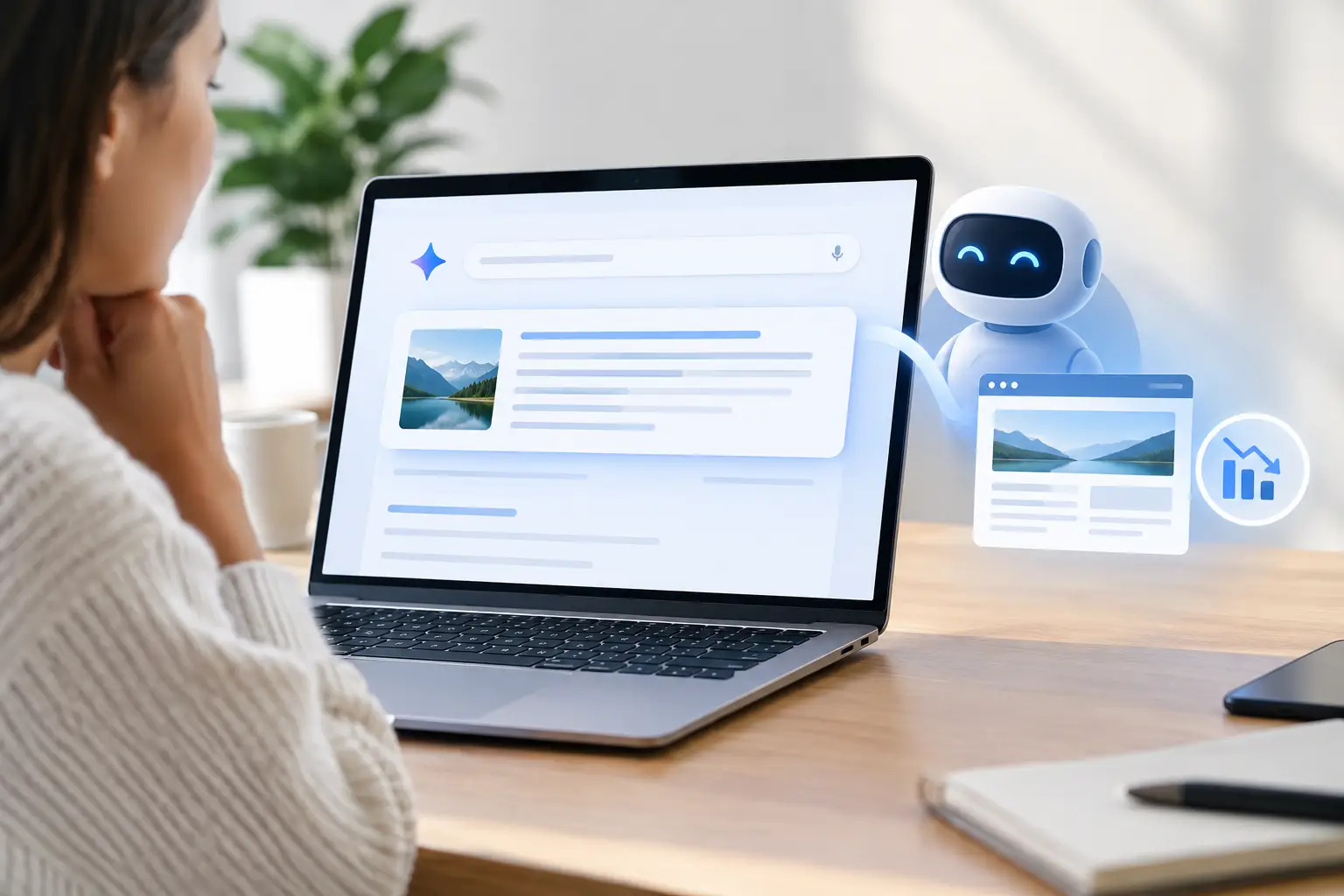


A customer searches “emergency plumber near me,” sees the answer they need in Google, checks the map, and calls a business without visiting a website. That is the reality behind the best zero click SEO tactics. A click is no longer the only win. For a small business, visibility that produces a call, direction request, booking, or brand recall can be far more valuable than a casual pageview.
Zero-click search is not a reason to abandon SEO. It is a reason to get sharper about what SEO is supposed to do: put your business in front of the right person at the exact moment they need an answer.
What Zero-Click SEO Means for Small Businesses
A zero-click search happens when someone gets enough information directly on the search results page or in an AI-generated answer and never opens a traditional web result. This can happen through Google Business Profiles, map packs, featured snippets, People Also Ask boxes, product information, knowledge panels, AI Overviews, and answers from AI search tools.
For an owner-operator, this creates an obvious concern: “If people do not click, how do I get leads?” The answer depends on the search.
Someone researching “how often should a roof be inspected” may not be ready to call anyone. A concise answer can build awareness without an immediate conversion. But a person searching “roof repair Los Angeles” is high intent. Your goal is to appear with clear proof, service details, reviews, and an easy next action before competitors capture the call.
The trade-off is that zero-click visibility can make traffic reports look less exciting while business outcomes improve. Track calls, form submissions, bookings, direction requests, branded searches, and revenue alongside organic sessions. Otherwise, you may mistake a changing search format for a failing strategy.
1. Treat Your Google Business Profile Like a Landing Page
For local businesses, the Google Business Profile is often the first website customers see. It needs the same care as a high-converting service page, not a set-it-and-forget-it setup from three years ago.
Use your real business name, correct primary category, accurate hours, service areas, phone number, and website. Add services in plain language that customers actually search for. A dentist should not rely only on “dental clinic.” Include services such as emergency dentistry, teeth whitening, dental implants, and same-day appointments where applicable.
Photos matter because they reduce uncertainty. Show the exterior, team, work in progress, finished results, equipment, and the experience a customer can expect. Keep them current. An empty profile with one blurry logo does not inspire confidence when a local competitor has 80 recent photos and consistent reviews.
Also use the Questions and Answers section strategically. Add accurate, helpful answers to common questions about parking, appointments, service areas, turnaround times, financing, or estimates. You are making it easier for Google and customers to understand your business without forcing either one to hunt for details.
2. Build Pages Around Questions With Real Buying Intent
The strongest zero-click content answers a question clearly, then gives a person a reason to choose your business when they are ready. That means avoiding fluffy, vague pages written only to repeat a keyword.
Start service pages with a direct answer. If the page is about termite inspections, explain what the service includes, when someone needs it, how long it takes, and what happens next. Put the practical answer near the top, then add the details that help a prospect make a decision.
Answer first, then show why you are credible
Search engines and AI tools favor content that is easy to extract and verify. Use descriptive headings, short paragraphs, specific service information, pricing context when possible, and clear geographic relevance.
Do not write “We provide exceptional solutions tailored to your needs.” That line says nothing. Write “Our Los Angeles termite inspections identify active damage, moisture risks, and conditions that can attract termites, with a clear report after the visit.” Specific language is easier to understand, quote, and trust.
For high-value services, include the questions prospects ask before calling: What does it cost? How long does it take? Do you offer emergency service? Are permits needed? What areas do you serve? The answers can earn zero-click visibility while filtering out poor-fit leads.
3. Win Featured Snippets Without Writing for Robots
Featured snippets are the boxed answers that can appear above traditional search results. They are not guaranteed, and Google changes layouts frequently, but they remain useful for informational searches that lead into your services.
Structure is the advantage. Place a direct answer of roughly two or three sentences below a question-based heading. Follow it with a short process, comparison, table, or checklist only when it genuinely helps the reader.
For example, a pest control company could answer “How do you know if you have termites?” with a simple explanation of mud tubes, hollow-sounding wood, discarded wings, and visible damage. Then it can explain why a professional inspection confirms the problem. The snippet provides the immediate answer; the page creates the confidence to take action.
Avoid trying to cram every possible question into one enormous FAQ page. Google and AI systems need topical clarity. A dedicated page about drain cleaning should answer drain-cleaning questions. A page about water heater repair should answer water-heater questions.
4. Make Reviews Part of Your Search Strategy
Reviews are zero-click conversion assets. Before a prospect reads your site, they may see your rating, review count, recent feedback, and owner responses in local results. That information can decide whether they call.
Build a consistent review request process after completed work, successful appointments, or delivered results. Ask customers to describe the service they received and the result in their own words. Never script reviews or pressure people for a five-star rating. Authentic detail is more persuasive and more credible.
Respond to reviews with care. Thank positive reviewers without copying the same canned reply every time. Address negative feedback calmly, protect customer privacy, and offer a practical next step. A thoughtful response does not erase a bad review, but it shows future customers how you handle problems.
5. Use Local Proof AI Search Can Recognize
AI-generated search answers increasingly pull together information from business websites, directories, reviews, local coverage, and structured data. They tend to reward consistency and recognizable expertise, not clever buzzwords.
Make your local footprint easy to verify. Keep your business details consistent across the web. Publish useful location-specific content when it reflects real expertise, such as neighborhood service areas, local regulations, seasonal issues, or project examples. A contractor writing about earthquake retrofit considerations in Southern California has more to say than a generic national article ever will.
Case studies are especially valuable. Describe the customer challenge, the work completed, the constraints, and the outcome without revealing private details. This creates evidence that supports both traditional SEO and AI visibility. It also gives real prospects a reason to trust you when an AI answer gives them only the basics.
6. Add Structured Data, but Do Not Expect Magic
Structured data is code that helps search engines interpret content such as your business details, services, reviews, FAQs, events, and products. It will not force Google to show a rich result, and it will not rescue weak content. Still, it removes ambiguity.
A local service business should prioritize accurate LocalBusiness information, service details, business hours, service areas, and relevant review markup where permitted. Ecommerce brands may need Product and Offer data. Businesses with legitimate educational content can use appropriate FAQ or article markup.
The key word is accurate. Markup must match what visitors can see on the page. Adding imaginary ratings, misleading availability, or every schema type under the sun is not strategy. It is a fast route to messy data and lost trust.
7. Measure Visibility Beyond Website Clicks
The best zero-click SEO tactics are only useful if you can connect them to business results. Set up call tracking carefully, monitor Google Business Profile actions, review lead quality, and ask new customers how they found you. Your sales team or front desk should have a simple way to log that information.
Review these signals each month:
- Calls, messages, bookings, and direction requests from local search
- Rankings and visibility for high-intent service and location terms
- Branded search growth, which often signals stronger awareness
- Review velocity, rating quality, and recurring customer themes
- Organic leads and revenue, not just organic traffic
- AI referral traffic and mentions where your analytics tools can identify them
There is no single dashboard that perfectly captures every zero-click interaction. That is frustrating, but it is not a reason to ignore the channel. Use a practical mix of platform data, analytics, CRM attribution, and customer feedback to identify what is creating real demand.
A Quick Zero-Click SEO Check Before You Spend More on Ads
Before increasing ad spend to compensate for weak organic leads, check whether your search presence answers the basics. Is your Google Business Profile complete and active? Do your main service pages answer urgent customer questions immediately? Are your reviews recent and credible? Can someone tell where you work, what you offer, and how to contact you in under 10 seconds?
If the answer is no, paid traffic may simply send more people into the same trust gap. Fixing that gap improves both SEO and advertising performance.
Zero-click search is not stealing your customers. It is raising the bar for earning their attention. Be the business with the clearest answers, strongest local proof, and simplest next step, and you will still be the one they remember when it is time to call.