

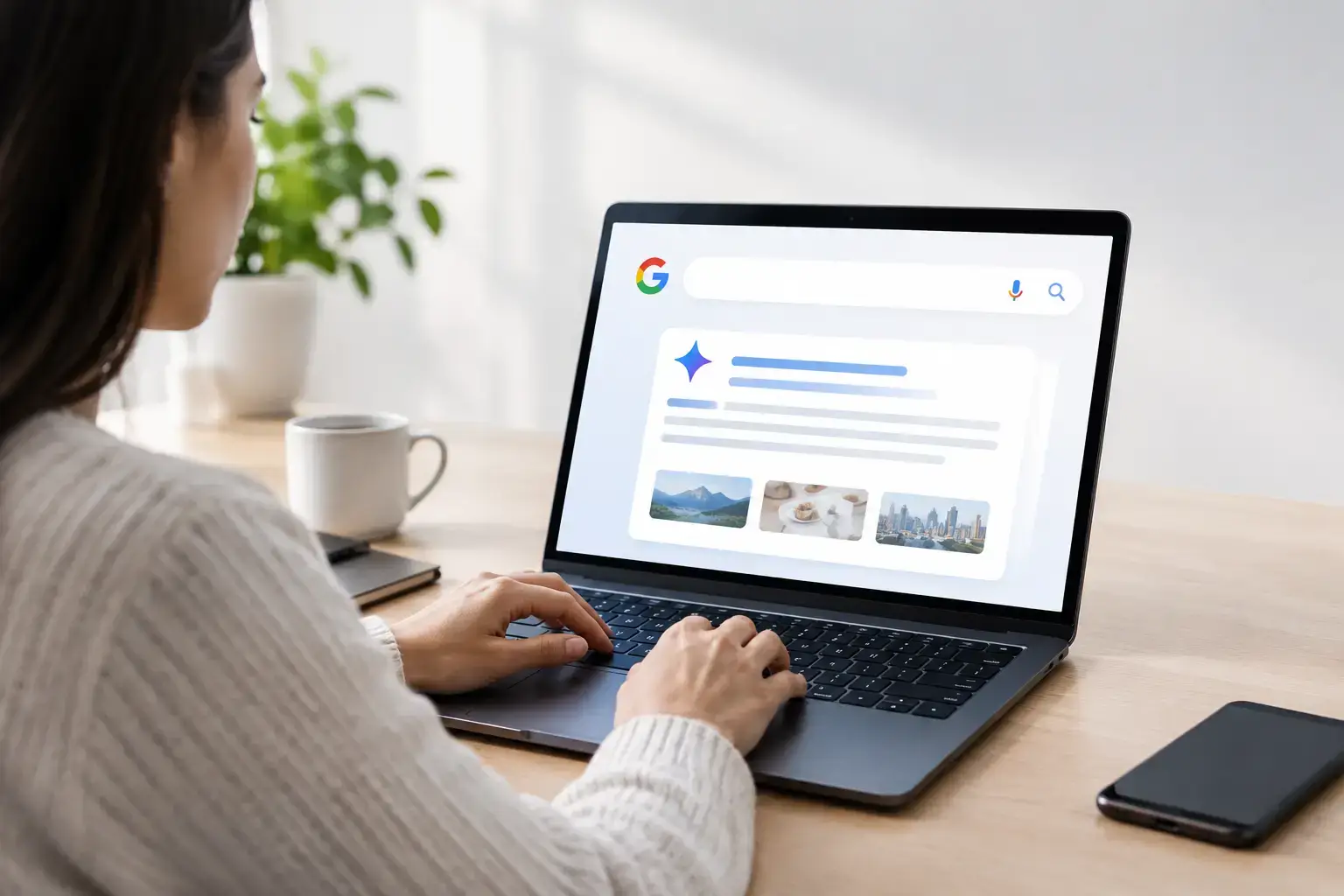
A Google AI Overview can answer a customer’s question before they ever reach the usual blue links. That changes the question from “How do I rank number one?” to how can you appear in Google AI Overviews? For a small business, the answer is not a secret AI trick. It is becoming the clearest, most credible source Google can use when it builds an answer.
That distinction matters. AI Overviews are generated based on the query, the available information, and Google’s assessment of which sources are useful. You cannot submit your business for inclusion or guarantee a citation. What you can do is make your website, local presence, and brand evidence easy for Google to understand and trust.
What Google AI Overviews Look For
Google AI Overviews are designed to handle complex searches, comparisons, recommendations, and questions that would otherwise require someone to open several pages. A homeowner might search, “What should I ask a roofer after storm damage?” A prospective patient might ask, “Does Invisalign work for crowded teeth?” A business owner might ask, “How much does commercial pressure washing cost?”
Google may assemble an answer and cite sources that support different pieces of it. One site may provide the definition, another may explain the process, and a local business may support the practical or geographic angle.
This means traditional rankings still matter, but an exact-match keyword page alone is rarely enough. Your content needs to answer the underlying question directly, show firsthand expertise, and hold up when Google compares it with other sources.
For local service businesses, relevance is especially contextual. A Los Angeles electrician should not try to out-publish every national home-improvement site. They should become exceptionally useful for the questions customers have about electrical work in Los Angeles: permits, older homes, panel upgrades, emergency response, pricing factors, and service-area realities.
How Can You Appear in Google AI Overviews? Start With Useful Answers
The strongest AI visibility strategy starts with customer questions, not marketing slogans. Review sales calls, estimate requests, customer emails, online reviews, and conversations your front desk has every week. These reveal the questions that create leads.
Create pages that answer one meaningful question or solve one clear problem. Avoid writing vague 300-word posts stuffed with variations of “best plumber near me.” Instead, explain what customers need to know before they call, what affects the cost, when the service is urgent, and what a qualified provider actually does.
A high-quality service page can cover the service, who it is for, common problems, process, timing, price variables, service area, and next step. A supporting article can go deeper on one decision, such as whether repair or replacement makes more financial sense.
Lead with the answer. If the page is about whether tree roots can damage a sewer line, say yes or no in the first few sentences, then explain the signs, risks, and options. AI systems do not need dramatic throat-clearing. Neither do busy customers.
Write from experience, not generic research
AI-generated content has made average information cheap. Your business advantage is the part a generic article cannot honestly replicate: firsthand knowledge.
Include details earned through doing the work. A contractor can explain why two homes with the same square footage receive very different bids. A med spa can clarify who may not be a candidate for a treatment. A lawyer can explain the documents clients should bring to an initial consultation, while avoiding promises about outcomes.
Use real project examples where appropriate, with customer permission and privacy in mind. Original photos, before-and-after context, staff credentials, process explanations, and clear policy details give Google more evidence that a real business stands behind the content.
Build the Trust Signals Behind the Answer
Google is less likely to surface a page that looks anonymous, outdated, or loosely connected to the business claiming expertise. Every important page should make basic facts easy to verify.
Your site should clearly identify the company, services, service areas, phone number, and ways to contact you. Include an About page that explains who leads the business and why customers trust them. For higher-stakes industries such as health, law, finance, and home safety, author credentials and careful editorial review matter even more.
Keep claims specific and supportable. “We have completed more than 500 installations” is more credible than “we are the industry leader.” If you cite pricing, results, or technical guidance, add the context that makes the statement honest. For example, explain that costs vary by materials, access, location, scope, and permits.
Freshness also has a role. Update pages when regulations, products, pricing conditions, or service offerings change. Do not change publication dates just to look current. Improve the information because customers and search engines both benefit when it is accurate.
Strengthen Local Signals Without Turning Pages Into Spam
AI Overviews may appear for local-intent questions, but location pages only help when they contain genuine local value. Copying the same page 20 times and swapping city names is a fast path to thin content.
Show where and how you serve customers. Mention neighborhoods or cities naturally when they are relevant, describe local logistics, display consistent business information, and maintain an accurate Google Business Profile. Ask satisfied customers for honest reviews, especially reviews that describe the service performed and the location in a natural way.
If you operate from one office but serve several nearby cities, build your site around real service areas rather than pretending to have locations everywhere. Accuracy beats inflated coverage claims. It protects trust and helps you qualify better leads.
For businesses with a physical location, keep hours, categories, services, photos, and contact details current across the web. AI visibility is not separate from local SEO. It is another reason the fundamentals need to be clean.
Make Your Website Easy to Crawl and Understand
Great content cannot help much if Google cannot access or interpret it. Technical SEO is the plumbing behind AI visibility: invisible when it works, expensive when it does not.
Make sure important pages are indexable, load well on mobile, use descriptive page titles and headings, and are connected through sensible internal links. A customer should be able to move from a broad service page to a detailed question page, then to a conversion page, without getting lost.
Use structured data when it accurately reflects what is on the page. Local business, service, product, review, FAQ, and article markup can help search engines understand context. It is not a magic pass into AI Overviews, and misleading markup can create problems. Treat it as clean labeling, not a ranking hack.
Also remove weak pages that compete with stronger ones. If your site has five nearly identical articles about the same service, consolidate them into one useful resource. Concentrated authority generally beats a pile of thin pages.
Measure More Than Clicks
AI Overviews create a real trade-off: some questions receive an answer directly on Google, so traffic may not rise even when your brand becomes more visible. That does not automatically mean the effort failed.
Track rankings, impressions, qualified calls, form submissions, booked appointments, direction requests, and revenue from organic leads. Watch which pages earn visibility for informational questions and which pages convert people who are ready to act. The goal is not vanity traffic. It is being present at the moments that influence a purchase.
Search results also change frequently. A query may show an AI Overview one week and standard results the next. Test content improvements over time rather than making major decisions based on a single screenshot.
Common Mistakes That Keep Businesses Out of the Conversation
The most common mistake is publishing content written for algorithms rather than people. Keyword repetition, fluffy introductions, and broad claims do not create a source worth citing.
Another mistake is treating AI optimization as separate from SEO. A fast website, strong local signals, useful service pages, genuine reviews, and credible expertise are not old-school tactics. They are the foundation that gives AI systems something reliable to reference.
Finally, do not chase every possible question. Prioritize the questions tied to your services, margins, location, and customer decision process. A focused content plan is more manageable for a lean team and far more likely to produce qualified demand.
Frequently Asked Questions
Can you guarantee placement in Google AI Overviews?
No. Google decides when an AI Overview appears and which sources it cites. A capable SEO strategy improves your eligibility by making your information useful, trustworthy, technically accessible, and relevant to the query.
Do AI Overviews replace traditional SEO?
No. Traditional SEO remains the engine underneath much of AI visibility. Pages still need to be crawled, indexed, relevant, well-structured, and credible. The difference is that content must also work as a clear source within a synthesized answer.
Should small businesses create content with AI?
AI can speed up outlining, research organization, and first drafts. It should not replace subject-matter review or firsthand insight. Publish only content your business can stand behind, verify, and improve with real experience.
The practical opportunity is simple: become the business that gives customers a straight answer before the competition gives them a sales pitch. If your site needs that kind of strategy, LAv1 can help turn search visibility into a pipeline of real conversations.