
A plumber in Los Angeles, a Shopify store selling skincare, and a national law firm can all target the same search term. So, how do search engines decide which websites rank first? They do not simply reward the business with the biggest budget, the most pages, or the oldest domain. They try to predict which result will solve the searcher’s problem best, fastest, and most reliably.
That sounds simple. The reality is a moving system with hundreds of signals, constant testing, and more context than most business owners realize. The good news is that the fundamentals are not mysterious: be the most relevant, useful, credible, and accessible answer for the customer you want to attract.
How Do Search Engines Decide Which Websites Rank First?
Search engines begin by understanding the search itself. A query such as “emergency plumber near me” has a very different intent than “how to fix a leaking faucet.” The first person likely needs to call someone now. The second may be researching a DIY repair. Ranking well means matching the job the searcher is trying to get done, not merely repeating a keyword on a page.
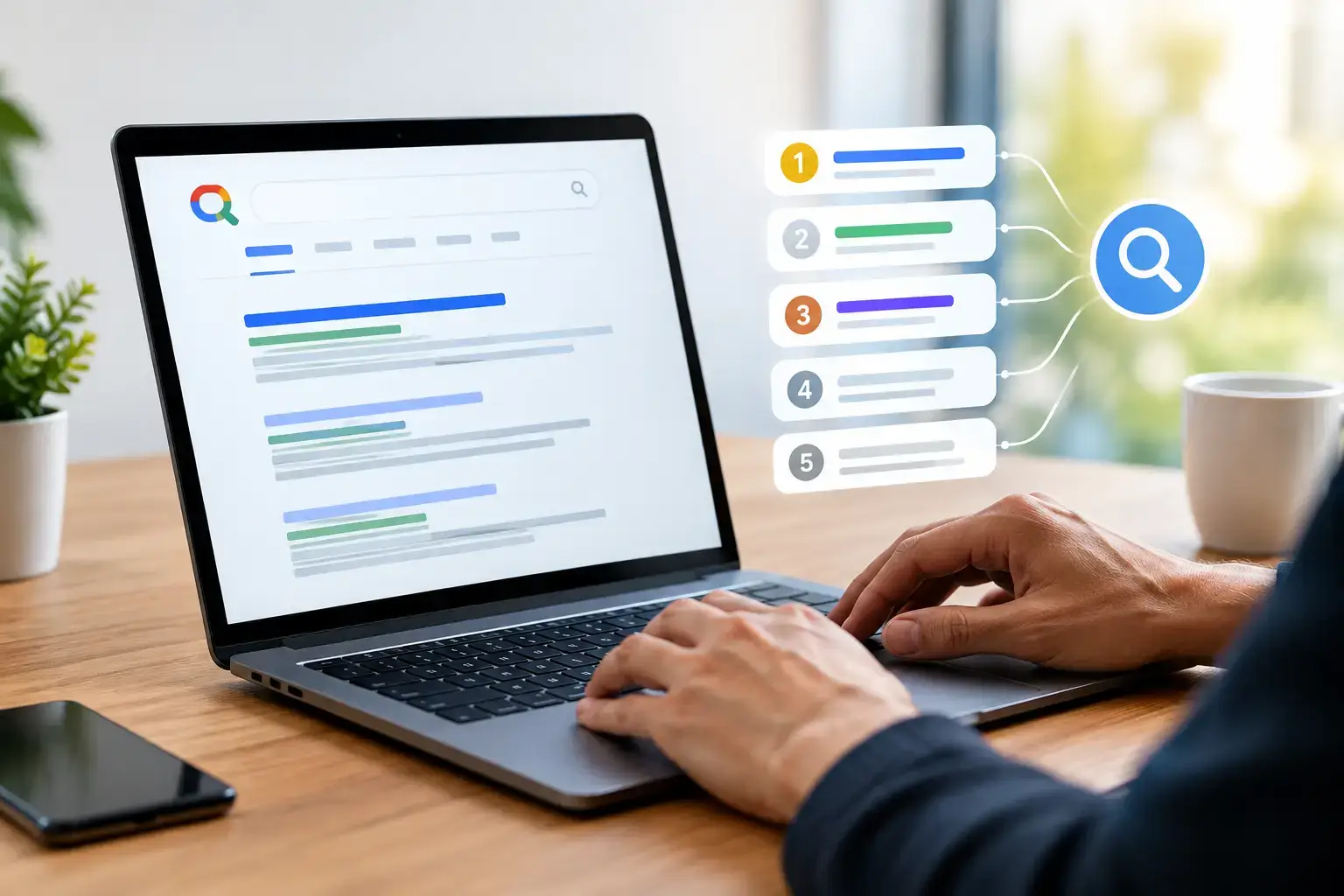
Next, the engine searches its index – its enormous catalog of crawled web pages – for candidates that may answer the query. It then weighs relevance, content quality, authority, location, usability, freshness, and other signals to organize results. Google’s exact formula is not public, and it changes regularly. Anyone promising a secret ranking switch is selling smoke.
The key distinction is this: search engines rank pages, not businesses in the abstract. Your homepage may deserve to rank for your brand name, while a service page may be the right page for “commercial roofing repair in Pasadena.” A useful page in the right context gives the algorithm a clearer reason to show your business.
Relevance Comes Before Everything Else
Relevance is the baseline. A page must clearly address the words a person uses and the underlying need behind them. If someone searches “affordable divorce lawyer Los Angeles,” a broad article about family law may be helpful, but a clear divorce-law service page with local details, fees or consultation expectations, and next steps is usually a closer match.
Search engines look beyond exact-match phrases. They understand related language, entities, topics, and context. A strong page about dental implants should naturally cover consultations, candidacy, procedure details, recovery, financing, and the practice’s location. Stuffing “best dental implants” into every other sentence will not make a thin page more useful. It may make it less trustworthy to real people.
This is why keyword research still matters, but only when it informs customer intent. The goal is not to chase every phrase with search volume. The goal is to create the best page for the searches most likely to produce calls, appointments, quotes, or sales.
Quality Is More Than Word Count
Long content can be excellent. It can also be 2,000 words of recycled filler wearing a keyword hat. Search engines increasingly evaluate whether content demonstrates real helpfulness and firsthand value.
For a small business, quality often shows up in practical details competitors skip: actual service areas, pricing ranges when appropriate, timelines, before-and-after explanations, original photos, team credentials, answers to common objections, and clear policies. These details help customers make decisions and help search engines understand that the page was built by a real business for real people.
Accuracy matters, especially in industries involving health, finance, legal services, safety, or major purchases. Claims should be supportable. Credentials should be easy to verify. If a page was last updated years ago and references outdated information, it can lose ground to a clearer, current alternative.
AI can accelerate outlines, research, and content production, but it cannot replace business experience. A generic AI-written city page that could apply to any company in any ZIP code is unlikely to build lasting visibility. Add your expertise, local proof, and customer knowledge before publishing.
Authority Helps Search Engines Trust You
Authority is often misunderstood as “get as many backlinks as possible.” Links still matter because a reputable site referencing yours can function like a vote of confidence. But not all votes carry equal weight. A relevant mention from a respected local publication, trade organization, supplier, or industry resource can be far more valuable than dozens of low-quality directory links.
Search engines also assess broader trust signals. Is your business consistently named across credible sources? Do people search for your brand? Are your reviews authentic and recent? Does your site identify who runs the company and how to contact them? Is your content aligned with the expertise you claim?
Authority compounds slowly. That can feel frustrating when a competitor appears overnight, but it is also good news. A business that earns legitimate mentions, publishes useful resources, and delivers a consistent customer experience creates an advantage that is difficult to copy with shortcuts.
User Experience Can Confirm or Undermine a Ranking
A relevant, authoritative page can still underperform if it is painful to use. Slow load times, intrusive pop-ups, tiny mobile text, broken forms, confusing navigation, and pages that jump around while loading create friction. Search engines want to avoid sending users to frustrating results.
Mobile experience deserves special attention. Many local searches happen when someone is on the move and ready to act. If a visitor has to pinch and zoom to find your phone number, wait ten seconds for a gallery to load, or complete a seven-field form just to request an estimate, you are making the next click easier for them.
Good user experience does not mean a flashy site. It means the page loads reliably, answers the question quickly, looks credible, and makes the next action obvious. For a service business, that may be a click-to-call button, a short quote form, clear service areas, and proof that you are qualified to do the work.
Local Rankings Follow a Different Set of Clues
For searches with local intent, search engines weigh proximity, relevance, and prominence. Proximity means the searcher’s location can influence what appears. A business in Santa Monica may have a natural advantage for a user standing in Santa Monica, even if a company in downtown Los Angeles has a stronger overall website.
Relevance means your business profile, website, categories, and service information need to clearly match the search. Prominence relates to your reputation and visibility across the web, including reviews, local mentions, and recognized business information.
You cannot control where a customer stands when they search. You can control whether your business information is accurate, whether your locations and services are clearly explained, and whether customers have a simple path to leave honest feedback. Local SEO is less about tricking the map and more about removing uncertainty.
Technical SEO Makes Your Best Content Eligible to Compete
Technical SEO is the plumbing behind the walls. Customers may never see it, but problems here can prevent great pages from being discovered, indexed, or understood.
Common issues include pages blocked from crawling, duplicate versions of the same page, weak internal navigation, missing page titles, broken redirects, and important content hidden behind scripts that do not load correctly. An ecommerce site can also lose visibility when product pages are accidentally removed, filters create thousands of duplicate URLs, or out-of-stock items lead users to dead ends.
A technically healthy website is not automatically a top-ranking website. It simply ensures the work you invest in content, reputation, and conversion is able to count.
What Changes With AI Search and Zero-Click Results?
Traditional rankings remain valuable, but customers are also getting answers from AI summaries, ChatGPT-style search experiences, and other answer engines. In many searches, the user may see a short answer before deciding whether to click any result at all.
That raises the bar for clarity. Content that directly answers a question, uses logical headings, provides specific facts, and demonstrates credible expertise is easier for search systems to interpret and cite. Brand consistency matters too. If your site says one thing, your business listings say another, and reviews tell a third story, trust becomes harder to establish.
The trade-off is that some informational searches may generate fewer clicks than they did before. But visibility still has value when it builds recognition and puts your brand in front of a qualified audience. The smart response is not to abandon SEO. It is to create pages that earn both the answer and the click when deeper help is needed.
Where Small Businesses Should Focus First
If your marketing time is limited, prioritize the work that improves customer decisions and search visibility at the same time:
- Build a clear, dedicated page for each core service, rather than forcing every service onto one vague page.
- Improve and maintain accurate business information, especially locations, hours, phone numbers, categories, and service areas.
- Collect honest reviews consistently and respond professionally, including when feedback is not glowing.
- Publish proof of your work through case studies, project examples, FAQs, team expertise, and original photos.
- Fix conversion friction on mobile so a visitor can call, book, request a quote, or buy without hunting for the next step.
Do not expect results from one edit or one month of activity. Competitive rankings are usually the outcome of repeated signals over time. Paid search can create immediate visibility, while SEO builds an asset that can reduce your dependency on paying for every visit.
A Better Question Than “How Do I Rank First?”
First place is not always the win owners imagine. A number-one ranking for a broad, low-intent phrase can deliver plenty of traffic and very few leads. A top-three ranking for a specific local service query can generate fewer visits but far more revenue.
Focus on the searches that indicate real commercial intent, then give those prospects a page that makes choosing you feel easy. Search engines are trying to recommend the best answer. Your job is to make your business the clearest, most credible, and most useful answer for the customers you want next.